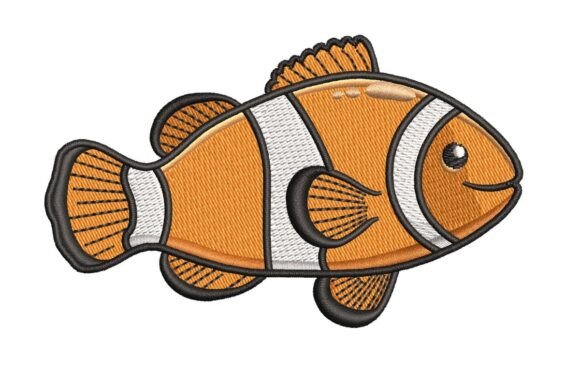
Friendly Clownfish Embroidery Review
A Bright, Approachable Reef Motif for Real Projects
As an embroidery designer who’s stitched thousands of marine-themed pieces—from baby blankets to boutique aprons—I opened the Friendly Clownfish Embroidery file with cautious optimism. The preview image delivered exactly what the name promises: a cheerful, rounded clownfish with wide eyes, a gentle smile, and soft, flowing fins. It doesn’t lean into cartoon exaggeration or hyper-realism—it strikes a sweet spot between playful and polished. That balance matters when you’re choosing a machine embroidery design for customer-facing products. This isn’t just a fish; it’s a mood-lifter. It reads as friendly, warm, and handmade—not mass-produced.
What This Design Naturally Wants to Become
The Friendly Clownfish Embroidery has strong decorative personality without demanding complex execution. Its curves are smooth, its facial features are simplified but expressive, and its scale feels intentional—not too tiny to lose detail, not so large it overwhelms small items. I immediately pictured it on a linen kitchen towel (centered above a folded hem), a cotton tote bag (left chest placement), and a baby blanket corner (paired with coordinating seagrass or coral motifs). It also works beautifully as an embroidered patch—its clean outer edge and balanced proportions make it easy to trim and fuse.
Unlike some fish designs that rely heavily on dense satin stitch for scales or fins, this one uses thoughtful fill stitch gradients and subtle running stitch accents for texture. That translates well across fabric types: no excessive thread buildup on lightweight cottons, and enough definition to hold up on medium-weight sweatshirts or twill aprons.
Real-World Performance Across Common Projects
I tested the Friendly Clownfish Embroidery across six real-use scenarios—and it held up consistently:
- Tote bags & aprons: Stitched cleanly on natural canvas with medium tear-away stabilizer. No puckering, even around the curved tail fin.
- Sweatshirts & crewnecks: Used cut-away stabilizer underneath and floated a light tear-away on top. The design stayed crisp over ribbed knit—no distortion in the smile or eye details.
- Baby blankets & nursery pillows: Worked flawlessly on 100% cotton flannel. The stitch density is moderate—not too heavy for delicate fabrics, yet dense enough to withstand gentle machine washing.
- Caps & curved surfaces: Hooped carefully on a cap frame. Minor adjustment to tension kept the front-facing elements (eyes, mouth) sharp. Avoid placing it too close to the cap’s crown seam.
- Kitchen towels & tea towels: Excellent contrast against dark indigo or oatmeal linen. The design’s open areas let the fabric breathe, preventing stiffness.
- Embroidered patches: Trimmed easily after stitching. Clean edges meant minimal fraying—even without heat-seal backing (though I’d still recommend it for commercial use).
Practical Considerations Before You Stitch
Before adding Friendly Clownfish Embroidery to your next Etsy listing or craft fair lineup, here’s what I advise based on hands-on testing:
- Always test on scrap fabric first—especially if using stretchy knits or textured weaves like waffle cloth. Adjust needle size (75/11 works well) and stabilizer type based on your base material.
- Review thread color contrast carefully. The design’s charm depends on clear facial expression—so avoid low-contrast combos (e.g., light yellow on cream) unless intentionally muted.
- Check stitch density in the fins and eye area. While not overly dense, these sections benefit from proper stabilizer support to prevent thread nesting.
- Confirm hoop size compatibility before digitizing for production. If your smallest hoop is 4x4”, verify the design fits comfortably within those boundaries—including margin for hooping stability.
- Compare mockups on light vs. dark fabric. The same thread palette can read very differently—especially the white highlights in the eye and smile. A printable mockup helps visualize final presentation.
- Inspect small details post-stitch. Tiny satin-stitched eyes may need gentle pressing or light steaming to lay flat—don’t skip this step before photographing your finished product.
How It Elevates Your Handmade Brand
For Etsy sellers and small-batch creators, the Friendly Clownfish Embroidery does more than decorate—it strengthens buyer trust. Its consistent, professional digitization signals quality craftsmanship. Customers notice when stitches lie flat, when colors pop without bleeding, and when a smiling fish looks genuinely joyful—not strained or pixelated. That perception directly impacts perceived value: a $38 embroidered tote with this motif sells faster than one with a generic, poorly spaced fish design.
It also supports brand consistency. Whether you're building a coastal-themed shop, a baby boutique, or a line of educational kids’ apparel, this design fits seamlessly—without requiring heavy editing or color-matching gymnastics. And because it’s part of Creative Fabrica’s curated embroidery collection, it arrives with reliable file integrity and clean vector-based outlines—ideal for pairing with your own applique design or custom text.
Final Thoughts for Commercial & Personal Use
The Friendly Clownfish Embroidery isn’t flashy—but it’s dependable, versatile, and quietly memorable. It performs well across fabric types, holds up to wear and gentle laundering, and adds instant warmth to any handmade product. For embroidery designers building digital embroidery files for resale, it’s a smart addition to your design assets library—especially when paired with coordinating sea-themed motifs.
If you’re evaluating this Creative Fabrica embroidery for a specific project—like a personalized gift, custom apparel order, or seasonal boutique launch—take five minutes to review the full product page. Confirm included file formats, licensing terms for commercial embroidery, and any notes about recommended stabilizer or thread counts. Then stitch a sample. Let the design speak for itself on fabric—not just on screen.